
The digital outcrop repository
A FAIR, AI-native cloud platform to publish, explore and collaborate on high-resolution 3D geological models. Upload your outcrops, view them in any browser, and share your science with the world.
Explore a digital outcrop in your browser
A real model streaming live from outcrop.io — drag to orbit, scroll to zoom and go full-screen. No software, no download.
Staithes, North Yorkshire — a digital outcrop model on outcrop.io.
An open home for digital outcrops
outcrop.io turns digital outcrop models from files on a hard drive into living, shareable science. Upload a model and it becomes something anyone can explore in a browser, search, cite and build on.
- Upload photogrammetry and LiDAR models and explore them in any browser
- Search a growing library of high-resolution digital outcrops
- Capture field observations and author documents alongside your models
- Collaborate with geoscientists worldwide — or share privately by invitation
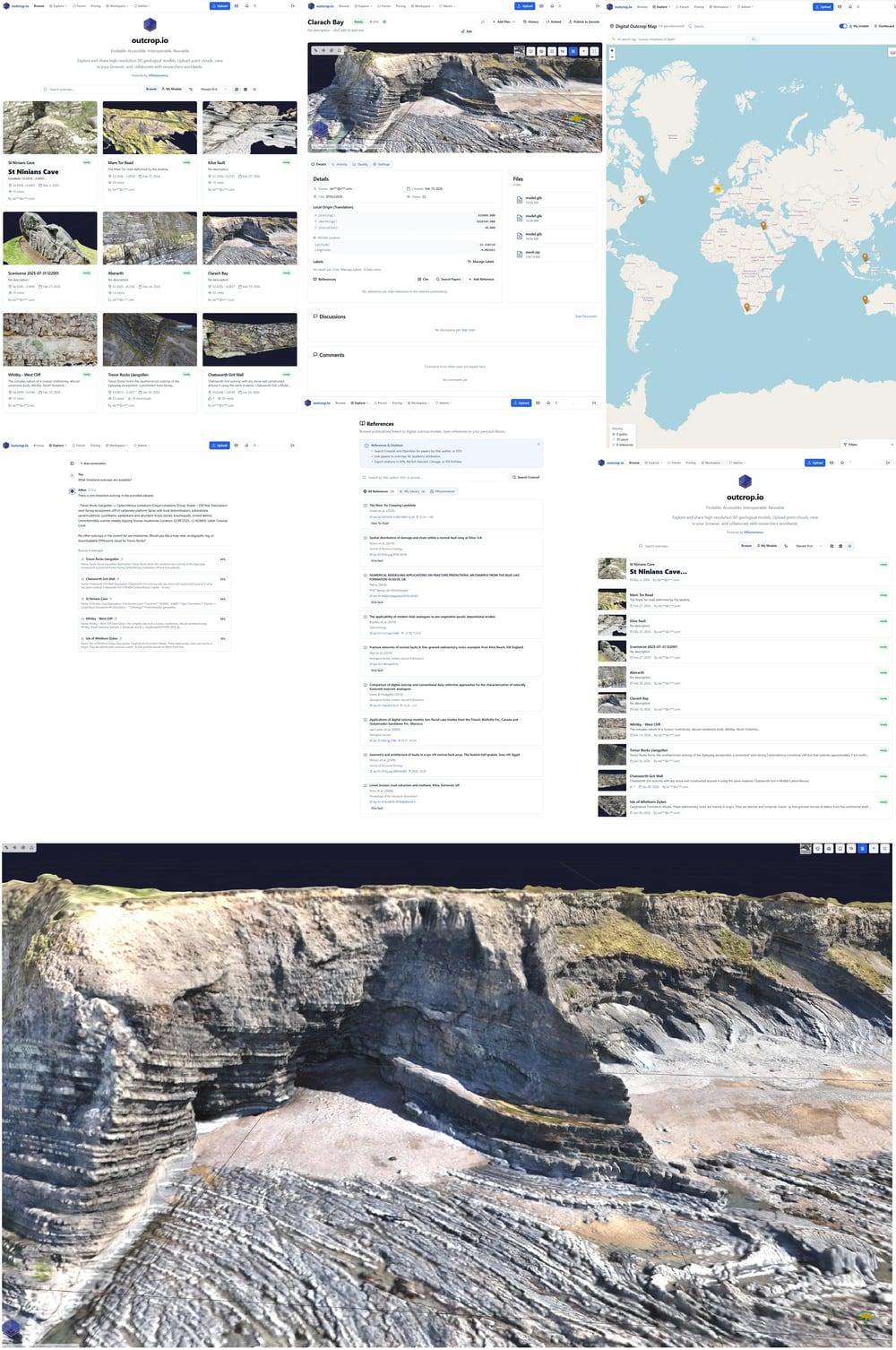
Browse, document and share digital outcrops at outcrop.io.
Findable, Accessible, Interoperable, Reusable
outcrop.io is built around the FAIR data principles — the standard for research data that lasts.
Findable
Every model carries rich, structured metadata and a stable home on the web — so the right outcrop surfaces the moment someone searches for it.
Accessible
Explore point clouds and meshes straight in your browser. No specialist software, no downloads — just a link you can share with anyone.
Interoperable
Open formats and a machine-readable model context (via an MCP server) let outcrop.io plug into VRGS, analysis tools and AI agents alike.
Reusable
Clear provenance, licensing and documentation mean models can be cited, taught with and re-analysed long after the fieldwork is done.
Not an archive. An AI-queryable platform.
Most outcrop libraries let you download a model. outcrop.io lets you query it. Field data, annotations and documents are indexed and exposed so both people and AI agents can find and reason over them.
A built-in MCP server
outcrop.io exposes your models through a Model Context Protocol server — a standards-grade interface that lets AI agents discover and use real outcrop data as a tool.
Semantic (RAG) indexing
Model metadata, annotations and documents are indexed for retrieval-augmented search, so you can find the right outcrop by meaning, not just by keyword.
Answers with Athos
Because the repository is machine-readable, the Athos assistant in VRGS can search across outcrop.io and reason over models in natural language.
Everything your outcrops need to live online
View in the browser
Stream high-resolution point clouds and meshes interactively — on a laptop, tablet or phone.
Capture in the field
Bring observations, photographs and locations in from the field and tie them directly to your models.
Author documents
Write up interpretations, field guides and virtual field trips alongside the 3D models they describe.
Share worldwide
Publish to a global community of geoscientists, or keep models private and share by invitation.
Annotate & discuss
Pin annotations, measurements and discussion to the rock, so collaboration happens in context.
Round-trip with VRGS
Move seamlessly between full interpretation in VRGS and sharing, search and collaboration on outcrop.io.
Built for everyone who works with outcrops
Researchers
Make your datasets FAIR, citable and reusable — and let others build on your fieldwork.
Educators & students
Take classes to outcrops anywhere in the world with browser-based virtual field trips.
Industry
Curate analogue libraries your teams can search, query and reuse across projects.
Put your outcrops on the map
outcrop.io is open for early users. Visit the platform to explore shared models, or get in touch to join the beta and publish your own.